

ETAIN RESEARCH ON INSECT EXPOSURE TO RADIO-FREQUENCY FIELDS
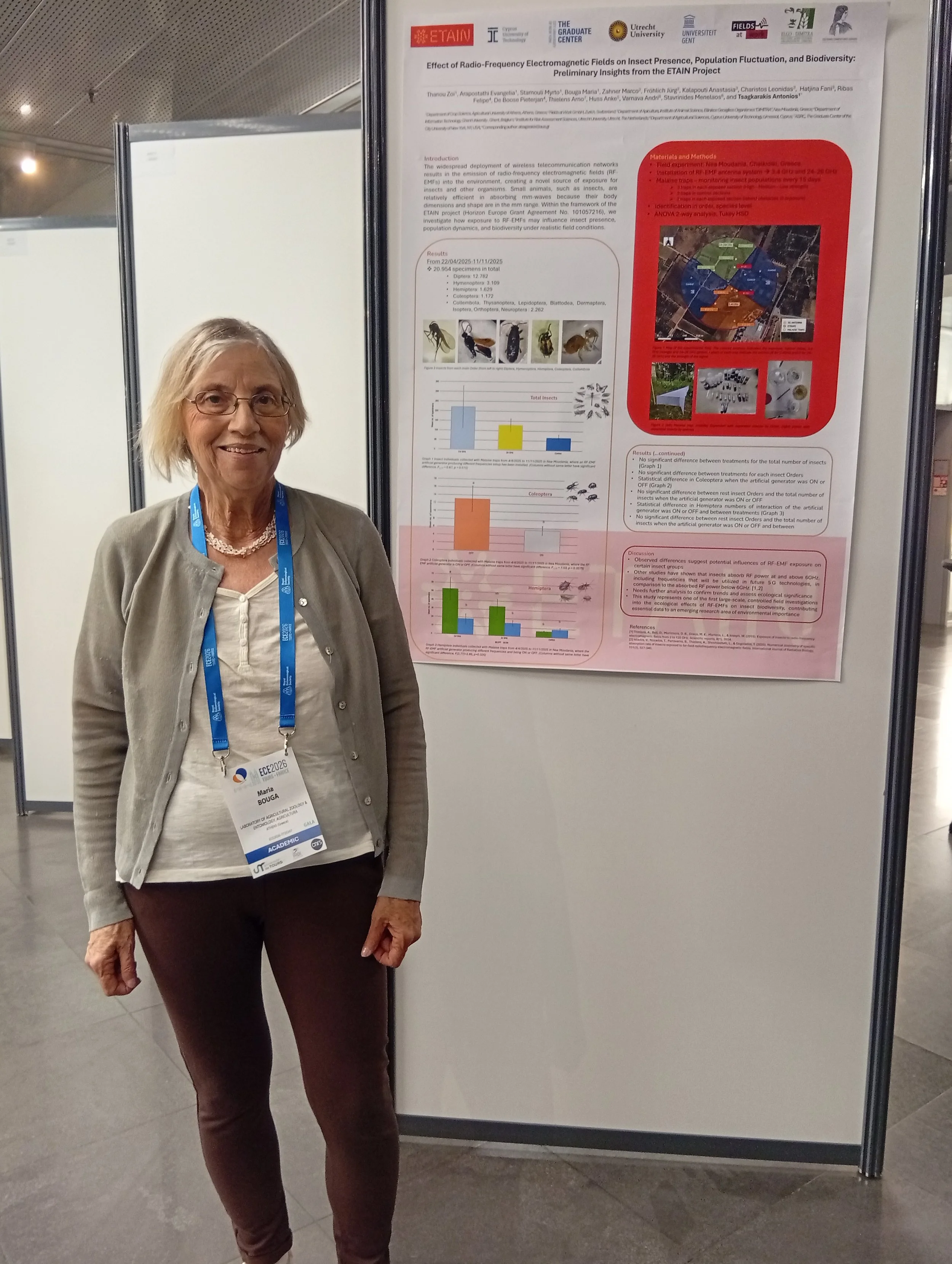
Maria Bouga (Agricultural University of Athens) and member of ETAIN 5G project, at the XIII EUROPEAN CONGRESS OF ENTOMOLOGY in Tours, France
Read the summary of our presentation at the XIII EUROPEAN CONGRESS OF ENTOMOLOGY in TOURS (FRANCE)
From 29th June to 3rd July 2026, the European Congress of Entomology brought researchers from many di?erent countries and continents to the Centre de Congrès Vinci in Tours, France. Among them were two members of the ETAIN consortium, Antonios Tsagarakis and Maria Bouga, from the Department of Crop Science at the Agricultural University of Athens, who presented a poster on one of the project's core research lines: How radio-frequency electromagnetic fields (RF-EMF)from telecommunication networks may a>ect insect populations biodiversity.
Why insects?
As 5G networks expand and 6G technology takes shape, the frequencies and wavelengths involved are moving into ranges that small organisms absorb differently than humans do. Because insects' body dimensions are in the millimeter range, they are comparatively e?icient at absorbing millimeter-wave radiation, the kind of signal increasingly used in modern networks.
ETAIN's biological research pillar looks at exactly this question, alongside its work on human skin and eye exposure, as part of a broader, planetary-health view of what network expansion means.
The study
The team, working with partners including Fields at Work, the Department of Apiculture at ELGO-DIMITRA, Ghent University, Utrecht University and the Cyprus University of Technology, set up a controlled field experiment in Nea Moudania, Chalkidiki, Greece. An RF-EMF antenna system was installed to generate two frequency ranges, 3.4 GHz and 24–26 GHz, across defined sections of the field, alongside control sections with no additional exposure and sections shielded behind obstacles.
Malaise traps monitored insect populations every 15 days between April and November 2025, with specimens identified down to order and, where possible,species level. Results were analysed using two-way ANOVA with Tukey HSD tests.
What they found
Over the monitoring period, the team collected 20,954 specimens in total, dominated by Diptera (12,782), followed by Hymenoptera (3,109), Hemiptera (1,629) and Coleoptera (1,172). Across the different exposure levels, there was no significant difference in the total number of insects collected, and no significant difference for most individual orders. However, two exceptions stood out: Coleoptera showed a statistically significant difference depending on whether the artificial RF-EMF generator was on or off, and Hemiptera showed a significant interaction effect between the generator's on/off state and the exposure treatment.
What it means, and what's next
The researchers are careful to frame these as preliminary results. They point to prior studies showing that insects absorb more RF power at and above 6 GHz, the range future 5G and 6G technologies increasingly use, than at frequencies below 6GHz, which offers a plausible mechanism for the differences observed in some orders. But confirming whether these are real ecological effects, rather than natural variation, will require further data collection and analysis.
What's clear already is the scale of the effort: this is one of the first large-scale, controlled field studies into the ecological effects of RF-EMF on insect biodiversity, and it contributes with specific data to a research area that, up to day, has offered none or very little.
Below, the full poster, with detailed graphs and methodology -use your right button to download.
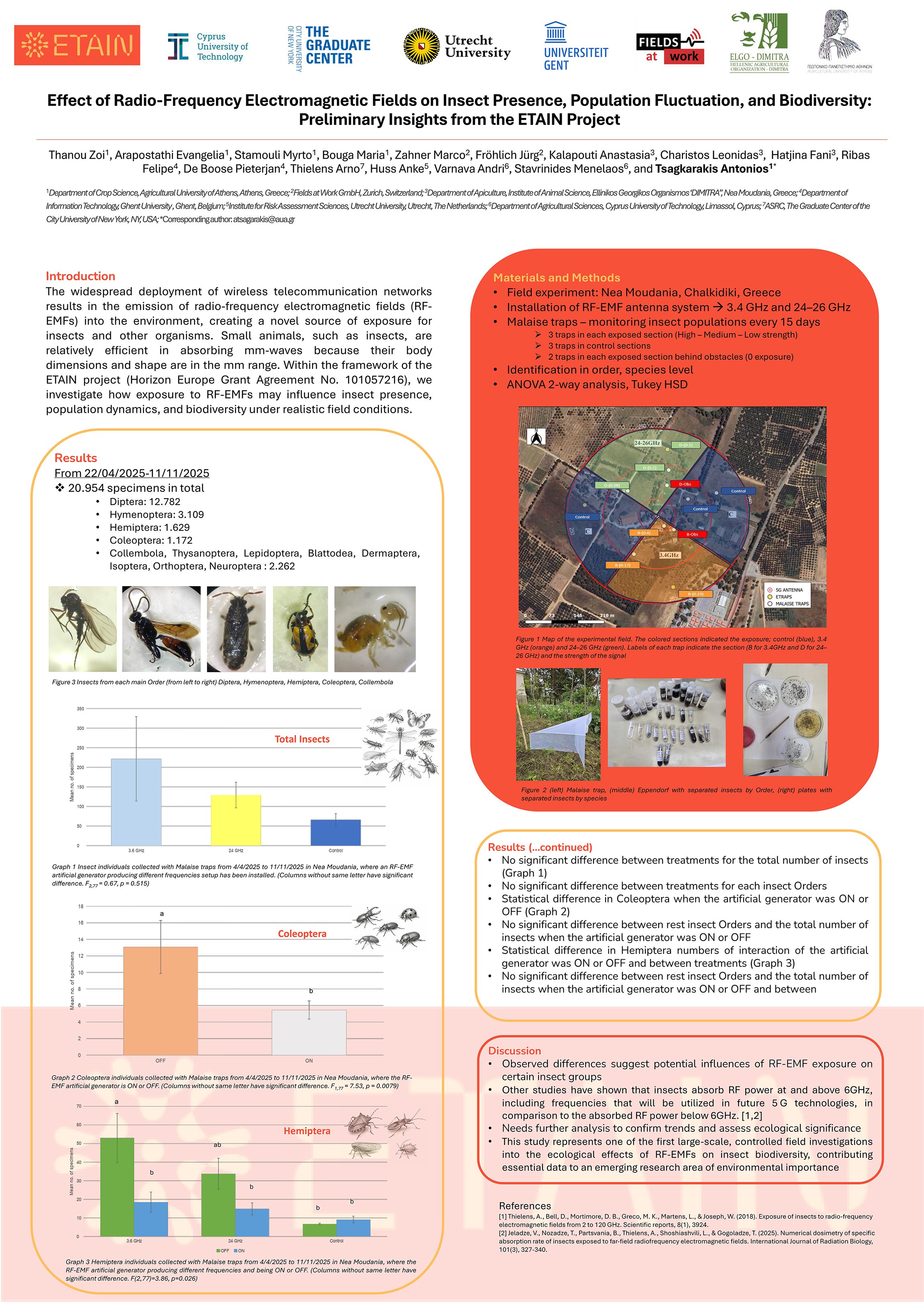
Poster authors: Zoi Thanou, Evangelia Arapostathi, Myrto Stamouli, Maria Bouga (Agricultural University of Athens); Marco Zahner, Jürg Fröhlich (Fields at WorkGmbH); Anastasia Kalapouti, Leonidas Charistos, Fani Hatjina (ELGO-DIMITRA);Felipe Ribas, Pieterjan De Boose (Ghent University); Arno Thielens (CUNY Graduate Center); Anke Huss (Utrecht University); Andri Varnava, Menelaos Stavrinides (Cyprus University of Technology); and Antonios Tsagarakis (Agricultural University of Athens), corresponding author.
